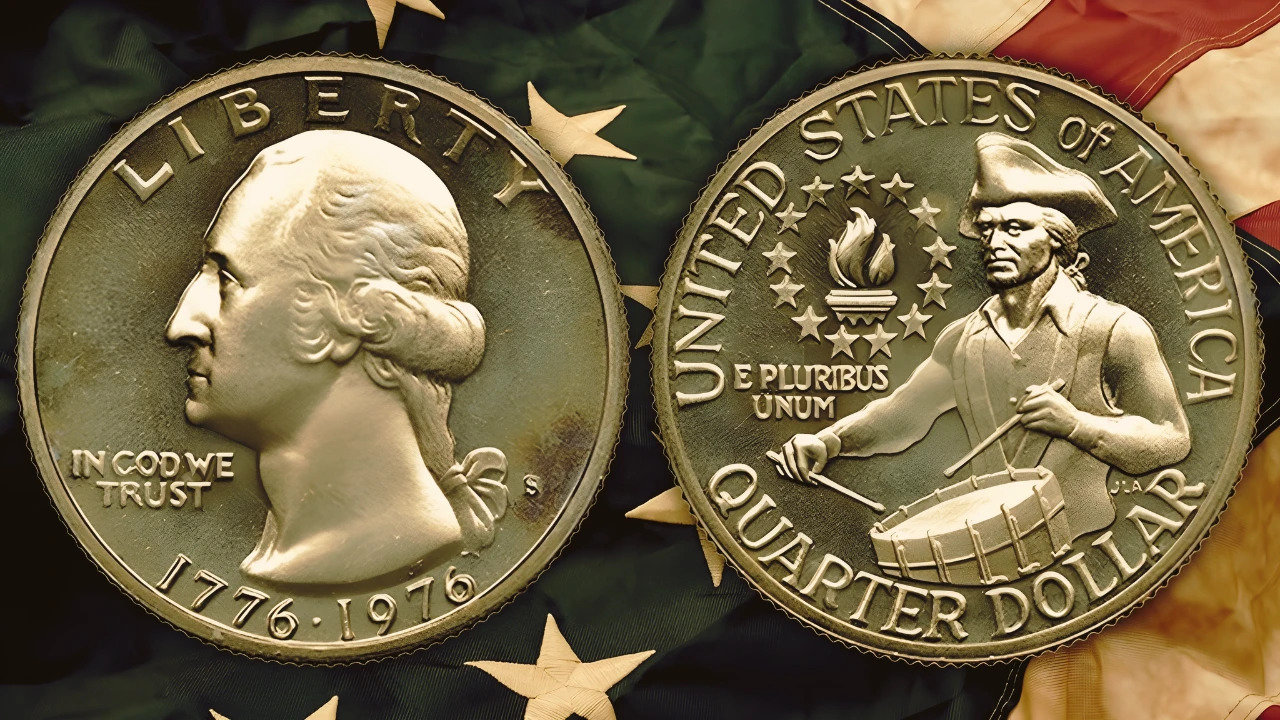
The 1976 Drummer Boy Quarter holds a special place in the history of American numismatics, as it was part of the nation’s bicentennial celebrations. This unique coin was minted to honor the 200th anniversary of American independence, and its reverse side features an image of a colonial drummer boy. Unlike the standard Washington quarter, this commemorative coin showcases a unique artistic design that captures the spirit of the Revolutionary War era, and it has become a cherished collectible among coin enthusiasts across America.
Historical Background Context
The United States Mint produced the Bicentennial Quarters between 1975 and 1976, although all coins bear the dual date “1776-1976,” regardless of their actual year of mintage. This distinctive design replaced the traditional eagle motif that had appeared on the reverse of the quarter since 1932. The decision to create commemorative coins was made by Congress, which sought to celebrate America’s 200th birthday with a tangible keepsake that every citizen could possess. Designer Jack L. Ahr won a national competition to create the Drummer Boy design; his patriotic vision triumphed over hundreds of other entries.
Design Features Explained
The obverse of the coin features the familiar profile of George Washington—a face instantly recognized by Americans—but the story on the reverse side is entirely different. The Drummer Boy image depicts a young colonial soldier beating his drum, accompanied by a torch of victory and thirteen stars; these thirteen stars represent the original thirteen colonies. The dual date “1776–1976” is clearly visible, making these quarters instantly recognizable even to the general public. The intricate details present in the drummer’s uniform and drum evoke a sense of historical authenticity, appealing to both coin collectors and history enthusiasts alike.

Minting Production Numbers
The United States Mint produced these quarters at three distinct facilities; each facility applied its own unique “mint mark” to distinguish its production output. The Philadelphia Mint struck coins without any mint mark, while the Denver Mint applied a “D” mark and the San Francisco Mint applied an “S” mark to its coins for special collectible editions. Total production exceeded 1.6 billion coins, a volume that ensures these coins remain quite easily found in general circulation today. The San Francisco Mint also produced special silver-clad editions for coin collectors; these coins utilized 40% silver rather than the copper-nickel alloy used in the coins intended for general circulation.
| Mint Location | Mint Mark | Circulation Coins | Silver Proof Coins | Composition |
|---|---|---|---|---|
| Philadelphia | None | 809,784,016 | 0 | Copper-Nickel |
| Denver | D | 860,118,839 | 0 | Copper-Nickel |
| San Francisco | S | 0 | 7,059,099 | 40% Silver |
Collector Value Assessment
Most Bicentennial quarters (twenty-five-cent coins) found in circulation hold only their face value—that is, twenty-five cents—due to their massive production numbers. However, certain specific coins can command a higher price based on their condition and finish. Uncirculated coins in “mint state” condition can sell for several dollars, while the silver-clad “proof” editions minted in San Francisco typically fetch between eight and fifteen dollars. Coins featuring minting errors or exceptional strike quality occasionally command higher prices at auction, though finding such coins is quite rare.

Condition Grading Importance
For serious collectors, the physical condition of the 1976 “Drummer Boy Quarter” has a profound impact on its market value. Professional grading services evaluate coins on a seventy-point scale, where higher scores indicate better preservation. Circulated coins—worn down by everyday use—rarely command a price higher than their face value, regardless of any sentimental attachment they may hold. Coins that never entered circulation retain their sharp details and original luster, making them far more appealing to collectors. The difference in value between a worn coin and a mint-state coin can amount to ten dollars or more.
Silver Content Distinction
For anyone evaluating these quarters, understanding the difference between standard circulating coins and the silver-clad editions is crucial. Standard Bicentennial quarters contain no precious metals; they consist of a copper-nickel alloy clad over a copper core. The silver-clad “Proof” coins minted in San Francisco weigh slightly more than their standard counterparts—5.75 grams compared to 5.67 grams. Collectors can identify these silver-clad coins by their “S” mint mark (indicating the place of mintage) and their mirror-like, lustrous surface; however, checking the weight remains the most reliable method.

Market Availability Today
Even fifty years after the initial release of the Bicentennial quarters, their massive production numbers mean that—surprisingly—it is still quite easy to find them in circulation. Banks, grocery stores, and vending machines continue to dispense these coins regularly in everyday transactions. Collectors seeking higher-quality specimens should look to coin shops, online marketplaces, and numismatic shows rather than relying solely on coins found in pocket change. Due to their widespread availability, the market prices for common examples remain stable, while patient collectors also have opportunities to assemble complete sets encompassing all mint marks.
Investment Potential Reality
Generally, the 1976 “Drummer Boy Quarter” is not considered a particularly strong investment opportunity when compared to rare American coins. Due to their massive production volume, the likelihood of common circulating examples appreciating significantly in value over time is limited—even if they are in uncirculated condition. Silver-clad versions are likely to command slightly higher prices, as they contain a higher proportion of precious metal and were produced in smaller quantities. Collectors should view these coins primarily as historical artifacts and conversation pieces, rather than as financial investments. They should also appreciate their cultural significance and artistic merit.
Cultural Legacy Impact
Beyond their monetary value, the Bicentennial Quarter serves as a tangible link to America’s 200th-anniversary celebrations and the legacy of the Revolutionary War. These coins introduced millions of Americans to the concept of commemorative coinage and sparked an interest in numismatics that has endured for generations. The image of the Drummer Boy reminds those who hold these coins of the young patriots who fought for independence, and every time someone views this design, it becomes an educational moment. This cultural value transcends market value, and that is why many families cherish these quarters as keepsakes.