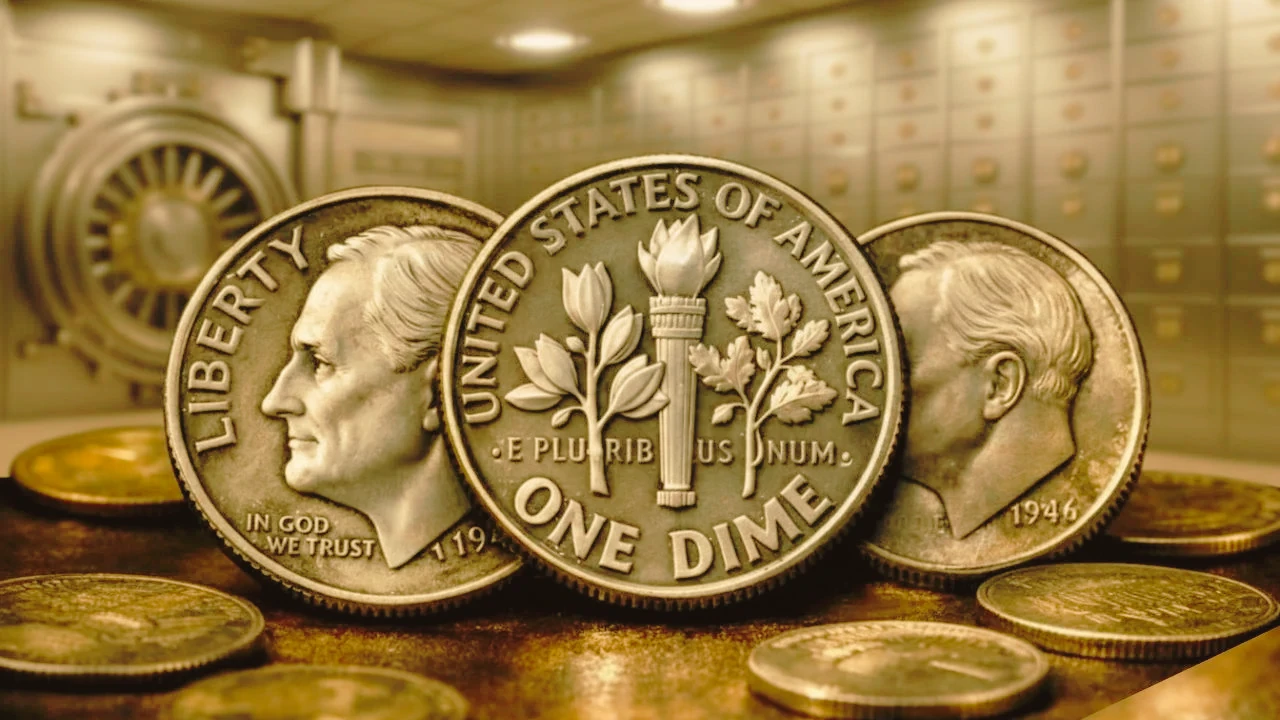
Roosevelt dimes have been a staple of American coinage since 1946, issued in honor of President Franklin D. Roosevelt, who passed away in 1945. While most Roosevelt dimes are worth merely ten cents, certain rare coins have become highly sought-after among coin collectors and numismatists across the United States. These exceptional coins—distinguished by their rarity, minting errors, or unique characteristics—can fetch thousands or even millions of dollars at auction. Understanding which Roosevelt Dimes hold significant value can help collectors identify those precious coins that may be hiding in plain sight.
Proof Roosevelt Dimes
The 1949-S Roosevelt dime ranks as one of the most valuable regular-issue coins in the entire series. With a mintage of just 13.5 million pieces, this coin—struck at the San Francisco Mint—has grown increasingly rare over the decades as many examples entered circulation and were subsequently lost or damaged. High-quality specimens graded in MS67 condition can command prices exceeding $30,000 at auction. The coin’s value appreciates rapidly with superior preservation, making the coin’s condition a critical factor for collectors seeking the finest examples.
Valuable Silver-Composition Coins
The 1975 “No S” Proof Dime stands as one of the most celebrated modern minting errors in American numismatics. Only two authenticated examples of this coin are known to exist, rendering it exceptionally rare and valuable. These Proof dimes were struck at the San Francisco Mint but were inadvertently issued without the “S” mintmark—a feature that should be present on all Proof coins produced in San Francisco. One specimen sold for $456,000 in 2019, while another fetched $516,000 in 2024; this underscores the tremendous demand for such rarities among serious collectors.

The Value of Mint Error Coins
The 1968 ‘No S’ proof dime shares a similar origin story to the 1975 coin, though it exists in slightly larger numbers. It is believed that approximately 20 to 30 specimens currently exist, although the exact count remains uncertain. These coins were distributed within special proof sets, and initially, no one noticed the absence of the mintmark on them. Despite being more readily available than the 1975 edition, the 1968 ‘No-S’ proof dime still commands a price ranging from $15,000 to $50,000; this valuation depends on the coin’s condition and prevailing market conditions at the time of sale.
Coins Without a Mintmark
The 1983 ‘No S’ proof dime continues the tradition of mintmark-less coins that captivates collectors. This specific error occurred during a transitional period when the U.S. Mint was implementing new quality control procedures. Only a handful of these coins have had their authenticity certified, making every new discovery a significant event for the numismatic community. Prices for these coins typically range between $500 and $2,000, although exceptional specimens in pristine condition can command values significantly higher than these estimates.

The “Full Bands” Designation
Roosevelt dimes featuring complete horizontal bands on the torch depicted on their reverse side are known as “full bands” or “FB” specimens. A high-grade 1946-D “full bands” dime represents a significant challenge for collectors striving to assemble a premium set. Millions of 1946-D dimes were produced at the Denver Mint; however, attaining the “Full Bands” (FB) designation requires exceptional quality. Coins graded MS67 FB can fetch anywhere from $5,000 to $15,000, reflecting both their technical quality and the difficulty involved in locating well-preserved specimens from the coin’s inaugural year of production.
Double-Die Coins
On the obverse of the 1964-D Double Die Roosevelt dime, a distinct doubling is clearly visible on Roosevelt’s portrait and the surrounding lettering. This variety occurred when the die received multiple impressions during the minting process, resulting in a doubling effect that is clearly discernible to the naked eye. Collectors highly covet these error coins due to their visually striking appearance and relative rarity. Depending on the intensity of the doubling and the coin’s overall condition, these pieces can range in value from $300 to $2,500, making them both accessible to intermediate-level collectors and a promising avenue for investment.

Special Strike Coins
The 1996-W Roosevelt dime holds particular significance as it is the only business-strike Roosevelt Dime ever produced at the West Point Mint. Specifically minted for inclusion in a special coin set commemorating the 50th anniversary of the Roosevelt dime series, only 1.4 million copies of this coin were struck. Unlike standard circulating coinage, these coins were never released into general circulation. High-grade MS68 examples can command prices between $100 and $500, while typical uncirculated specimens are generally valued between $25 and $75.
Roosevelt Dime Values
| Coin Year & Type | Mintage/Known | Average Grade Value | High Grade Value |
|---|---|---|---|
| 1949-S | 13.5 million | $15-$50 | $30,000+ (MS67) |
| 1975 No-S Proof | 2 known | N/A | $456,000-$516,000 |
| 1968 No-S Proof | 20-30 estimated | $15,000-$25,000 | $50,000+ |
| 1983 No-S Proof | Less than 10 | $500-$1,000 | $2,000+ |
| 1946-D FB | Unknown | $50-$200 | $5,000-$15,000 (MS67) |
| 1964-D DDO | Unknown | $300-$800 | $2,500+ |
| 1996-W | 1.4 million | $25-$75 | $100-$500 (MS68) |
The market for rare Roosevelt dimes is steadily expanding, as an increasing number of collectors recognize the potential value hidden within this readily accessible series. Unlike other types of vintage coins, which often require substantial financial investment, Roosevelt dimes offer opportunities for collectors across a wide range of budget levels. From affordable varieties like the 1996-W to highly prized coins such as the “No-S” proofs, this series offers something for everyone interested in American numismatics.
Understanding grading standards becomes crucial when seeking rare Roosevelt dimes, as even minor differences in condition can result in a difference of thousands of dollars in value. Professional grading services provide authentication and impartial evaluation, thereby safeguarding both buyers and sellers in the market. Collectors should familiarize themselves with grading terminology and examine multiple examples before making significant purchases.