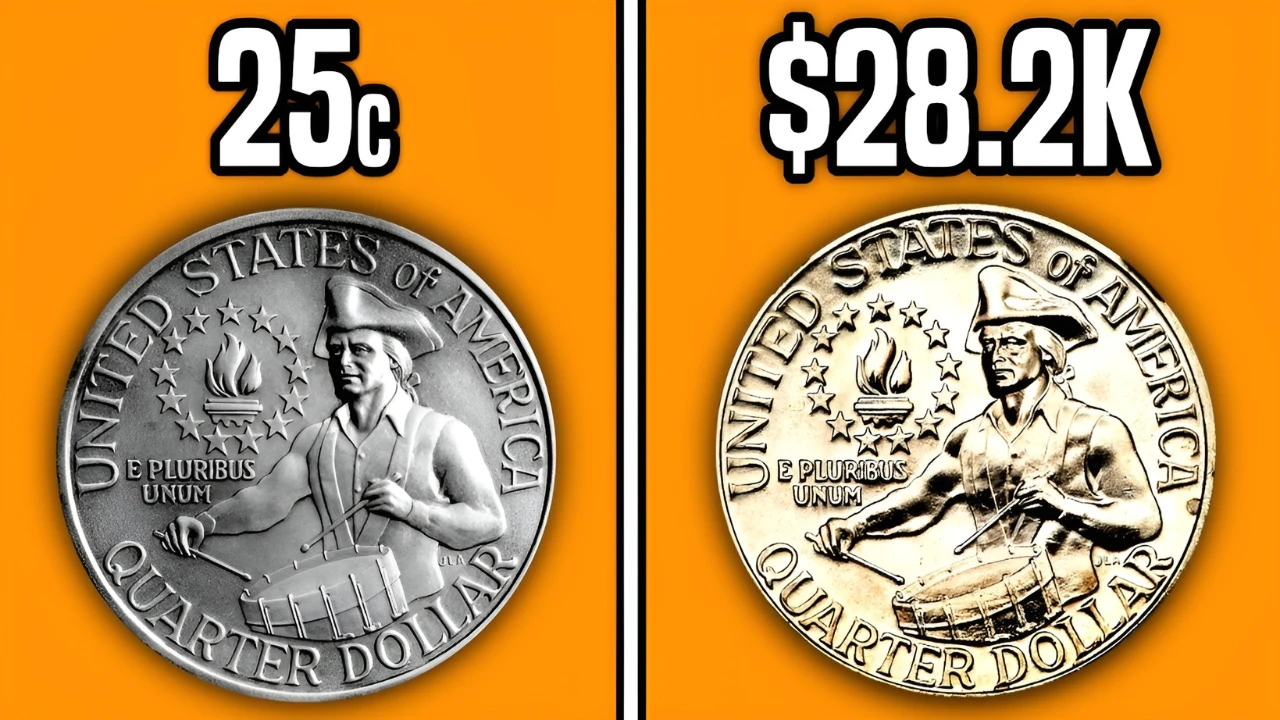
The rare Bicentennial Quarter stands as one of the most intriguing specimens in the history of U.S. coinage. Minted in 1975 and 1976 to celebrate America’s 200th birthday, the reverse side of these quarters features a unique “Colonial Drummer” design rather than the traditional eagle. Although millions of Bicentennial Quarters were produced, certain rare varieties have become extremely valuable; some of these specimens fetch thousands of dollars at auction. The combination of historical significance, the limited availability of “error coins,” and specimens of exceptional quality has transformed these commemorative coins into a serious investment opportunity for collectors across America.
Historical Background Context
The Bicentennial Quarter was part of a three-coin series that also included special “Half Dollar” and “Dollar” coins. Congress authorized these commemorative designs in 1973, and the U.S. Mint began their production in 1975. All bicentennial quarters bear the dual date “1776-1976,” making them instantly recognizable.
Jack L. Ahr, a designer from Arlington Heights, Illinois, won the competition to create the coin’s reverse design. His depiction of a “Colonial Drummer Boy”—accompanied by a “Victory Torch” encircled by thirteen stars—perfectly captured the spirit of American independence. More than 1.6 billion Bicentennial Quarters entered circulation, yet most Americans remain unaware that certain specific varieties among them are worth far more than their face value.
What Makes Them Valuable
Not all Bicentennial quarters are rare or valuable, a fact that often surprises the many people who stumble upon these coins while rummaging through the loose change in their pockets. Their value depends on several key factors, including the mint mark, metal composition, the coin’s condition, and any errors that may have occurred during production. Copper-nickel clad coins that have been in general circulation are typically worth no more than their face value—unless, of course, they are in pristine, uncirculated condition.

Truly valuable specimens include the 40% silver coins that were sold in special “collector sets,” as well as coins featuring significant minting errors, or those certified by professional grading services as being in perfect or near-perfect condition. While an ordinary Bicentennial quarter found in general circulation might be worth just 25 cents, a rare “error coin” or a high-quality silver specimen could fetch anywhere from hundreds to thousands of dollars at specialized auctions.
Silver Composition Specimens
The U.S. Mint struck 40% silver Bicentennial quarters specifically for collectors; these were never intended for general circulation among the public. These silver coins feature an inner core composed of 80% copper and outer layers containing 40% silver, giving them a distinct appearance and weight compared to standard clad coins. Approximately 7 million silver Bicentennial quarters were minted at the San Francisco Mint.
These silver coins were issued within special mint sets and proof sets, which were sold directly to coin collectors. You can identify them by their “S” mint mark and their slightly distinct coloration. In pristine condition and housed in original government packaging, Bicentennial silver quarters can fetch anywhere from $20 to $50, while coins in perfect grades have sold for several hundred dollars.

Error Coins Worth Thousands
Minting errors produce the most valuable Bicentennial quarters, with some examples commanding exceptionally high prices. Double-die errors—where the design appears duplicated due to a misalignment of the die—are particularly prized among serious collectors. Errors such as off-center strikes, coins struck on incorrect planchets (blank metal discs), and missing clad layers also command significant premiums in today’s market.
One famous error occurs when quarters are struck on dime planchets; this results in coins that are underweight and feature irregular edges. Another valuable error is the “No S” proof—a San Francisco Mint proof coin that was accidentally produced without a mint mark. These error coins have sold for thousands of dollars at auction; depending on the severity of the error and the rarity of the coin, certain specific examples have fetched prices exceeding $10,000.
Grading and Condition Impact
Professional grading has a profound impact on the value of Bicentennial quarters; in the world of numismatics, a coin’s condition is paramount. The Sheldon Scale assigns grades to coins ranging from 1 to 70, utilizing designations such as “MS” (mint state) and “PR” (proof) for uncirculated specimens. A bicentennial quarter graded MS-67 or higher becomes many times more valuable than its lower-graded counterparts.

Services such as PCGS and NGC authenticate and grade coins—encasing them in sealed holders—thereby instilling confidence in buyers and establishing market values. A silver Bicentennial quarter graded MS-68 can sell for over $1,000, while an MS-70 graded coin—considered absolutely flawless—can fetch several thousand dollars. Even common clad versions in MS-67 condition have sold for hundreds of dollars to collectors seeking pristine specimens.
Bicentennial Quarter Value Guide
| Type | Condition | Approximate Value |
|---|---|---|
| Clad Regular Strike | Circulated | $0.25 – $1 |
| Clad Regular Strike | MS-65 | $5 – $15 |
| Clad Regular Strike | MS-67+ | $100 – $500 |
| 40% Silver | Uncirculated | $8 – $20 |
| 40% Silver | MS-67 | $200 – $600 |
| 40% Silver | MS-68+ | $1,000 – $3,000 |
| Error Coins | Varies | $500 – $10,000+ |
Investment Potential Today
The market for rare Bicentennial quarters is steadily expanding, as young collectors enter the hobby and seasoned numismatists strive to complete high-grade registry sets. The 50th anniversary of the bicentennial celebrations in 2026 has sparked renewed interest in these commemorative coins. Over the past decade, auction prices for pristine specimens have consistently risen, signaling the potential for significant future appreciation in their value.
Discerning collectors focus on acquiring specimens that have been professionally graded, possess strong eye appeal, and are accompanied by documentation of their provenance. While common circulating coins are available in abundance, the supply of high-grade and error specimens is finite and limited. As veteran collectors liquidate their holdings and new enthusiasts compete for the finest examples, market conditions favor a continued appreciation in the value of truly rare Bicentennial quarters that survive in exceptional condition.